"The Room Where No One Needs You"
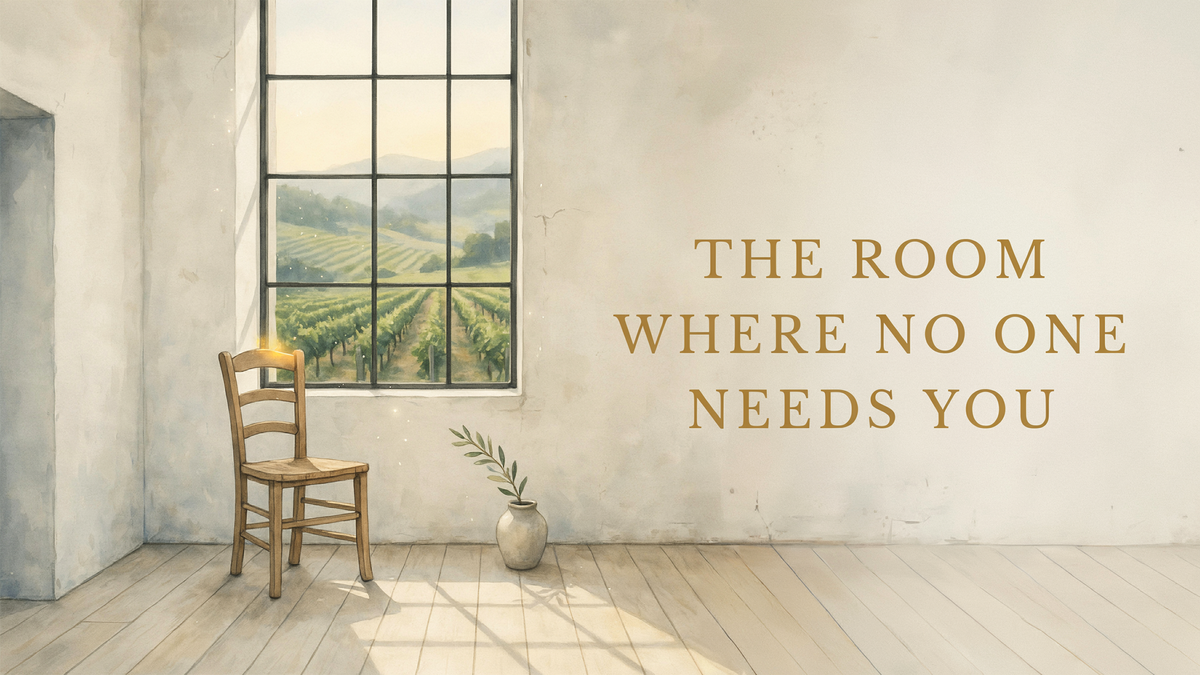
On the difference between being alone and being unreachable — and what you can only hear once you stop being available.
In Late Harvest, there is a cottage.
It sits at the edge of a working vineyard outside Stellenbosch, and Dominique goes there to vanish. Readers write to me about that cottage more than almost anything else in the book — not to ask what happens in it, but to ask, a little embarrassed, how they might find one of their own.
I understand the question better than I’d like to.
For most of my life I confused two things that look identical from the outside and could not be more different underneath: being alone, and being unreachable. I was alone often. I worked early, I worked late, I sat by myself in a great many quiet rooms. But I was never, for one hour, unreachable. The phone knew where to find me. The list knew. The people who had learned that I would always answer knew. I called it solitude. It was just a quieter shift of the same job.
Here is the distinction I missed: being alone is a location. Being unreachable is a decision. And the strong ones — the dependable ones, the ones everyone calls when it falls apart — almost never make the decision. We will take the empty room. We will not take the closed door. Because the closed door means someone, somewhere, might need us and not be able to get through, and we have built an entire identity on being the one who can always be gotten through to.
So we stay available, and we call the exhaustion something else.
What Dominique finds at the cottage is not rest. It’s the thing rest was hiding. When you finally become unreachable — when the door is genuinely closed and the phone genuinely doesn’t know where you are — the first thing you meet is not peace. It’s panic. A low, surprising panic, because the constant hum of being needed turns out to have been load-bearing. It was holding up a wall you didn’t know you’d built your whole house against.
And then, if you stay — this is the part I most want you to know — the panic burns off. Underneath it is the quietest sound you’ve ever heard, which is the sound of your own life with no one else’s voice in it.
Most of us have never heard it. We’ve been available since we were young enough to learn that being needed was the same as being loved. We have never once let the room go fully silent, because we were afraid of exactly this: that if no one needed us, there would be nothing there.
There is something there. That’s the whole secret. The room where no one needs you is not empty. It’s the only place you can finally hear what you need — a sound that has been drowned out, for years, by the much louder sound of everyone else.
I won’t romanticize it. Becoming unreachable, even for an afternoon, costs something. People who relied on your always-answering will feel the door close, and they will not love it. Some of them will tell you so. Dominique loses things at that cottage; so does anyone who stops being on call. But she gains the one thing she arrived without knowing she was missing: a few hours in which she is not a function. Just a woman, in a room, with her own quiet returning to her like blood to a limb she’d been sitting on.
You don’t need a vineyard. You need a closed door and the nerve to leave it closed longer than is comfortable. An afternoon. A morning before the city wakes. One block of time in which you are deliberately, unapologetically, unreachable.
The first twenty minutes will be panic. Stay.
The quiet underneath is yours. It always was.
In sovereignty,
Carly